

What is an Animated GIF? History and Evolution
The animated GIF has become one of the defining visual formats of internet culture. It is used for reaction clips, memes, tutorials, product demos, and art — yet most people who use GIFs every day have no idea how the format actually works or where it came from. Here is the full story.
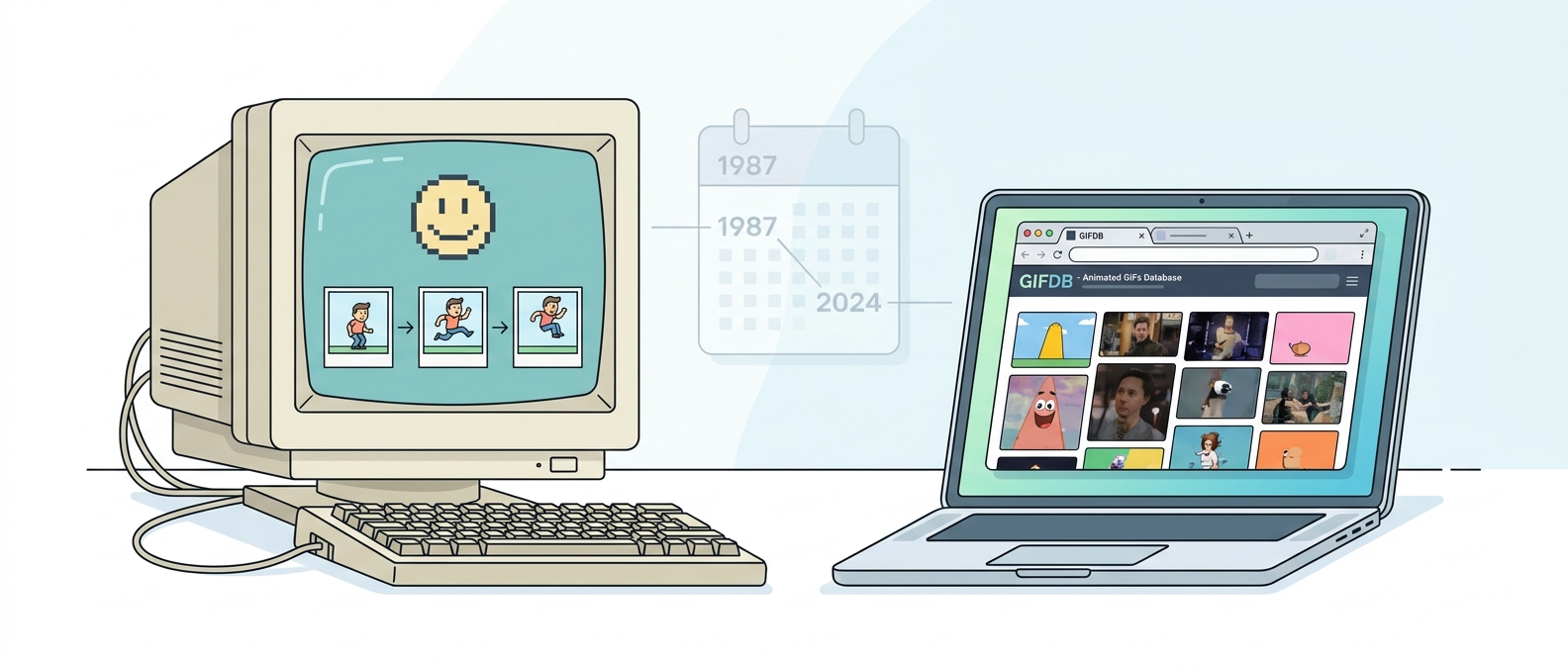
Origins: CompuServe, 1987
GIF — which stands for Graphics Interchange Format — was created by software engineer Steve Wilhite at CompuServe and first published on June 15, 1987. CompuServe was an early online service provider in an era before the World Wide Web existed. The company needed a way to transmit color images across slow modem connections, and existing formats were too large or too limited. Wilhite designed GIF using LZW lossless compression (developed by Abraham Lempel, Jacob Ziv, and Terry Welch in 1984) and a color palette system that supported up to 256 colors — the full range of what typical computer monitors of the time could display.
The original GIF87a specification was purely for static images. CompuServe updated the format in 1989 with GIF89a, which added several features including the ability to store multiple image frames and specify timing delays between them. This was the technical foundation for animation — though it would be years before software took full advantage of it.
The Animation Era: Early 1990s
As the World Wide Web grew in the early 1990s, web designers discovered that GIF89a's multi-frame support could be used to create looping animations displayed directly in browsers without any plugins. Early web design tools began including GIF animation features, and animated GIFs became one of the defining visual elements of 1990s websites — flashing banners, spinning logos, "Under Construction" warning signs, and decorative borders. The aesthetic was garish by modern standards but represented genuine creative experimentation with the new medium.
The Decline and the Patent Problem
In 1994, Unisys announced that it owned the patent on the LZW compression algorithm used by GIF and began demanding licensing fees from software developers using the format. This sparked significant controversy and a movement to develop a patent-free alternative. The result was the PNG format (Portable Network Graphics), which offered better lossless compression and full color support without patent restrictions. PNG largely replaced GIF for static images in web design through the late 1990s and 2000s. The LZW patent expired in 2004, removing the legal barrier to GIF use, but by then PNG had established itself as the superior static image format.
The Comeback: Reaction Culture and Social Media
GIF might have faded entirely if not for a cultural shift in the 2000s and early 2010s. Tumblr, Twitter, and Reddit became home to a vibrant reaction GIF culture, where short looping clips — often sourced from TV shows, movies, and news footage — became a primary mode of emotional expression in online conversation. The GIF's lack of audio and infinite looping made it perfect for this purpose. By the mid-2010s, GIPHY had built a searchable library of millions of GIFs and integrated with every major messaging platform, cementing the format's role in digital communication.
GIF Today
Today, animated GIF is technically outpaced by formats like WebP and AVIF, and by video formats like MP4 and WebM. Most platforms that display "GIFs" are actually serving MP4 video behind the scenes for efficiency. Yet the GIF format persists because of cultural weight, universal compatibility, and the simple fact that it works everywhere without configuration. It is one of the rare cases where an inferior technology survives on the strength of its cultural meaning.
For the technical details of how GIF compares to modern alternatives, see the guides on GIF vs MP4 and GIF vs WebP. For the full collection of GIF format information, visit the main GIF format guide. And to see modern GIF culture in action, browse the funny, anime, and cat GIF collections on GIFDB.