

GIF vs WebP: Complete Comparison
WebP is Google's modern image format that supports both static and animated images. On paper, animated WebP beats GIF in almost every technical measure. In practice, the right choice depends on your browser compatibility requirements and where you are delivering the content. Here is a clear comparison.
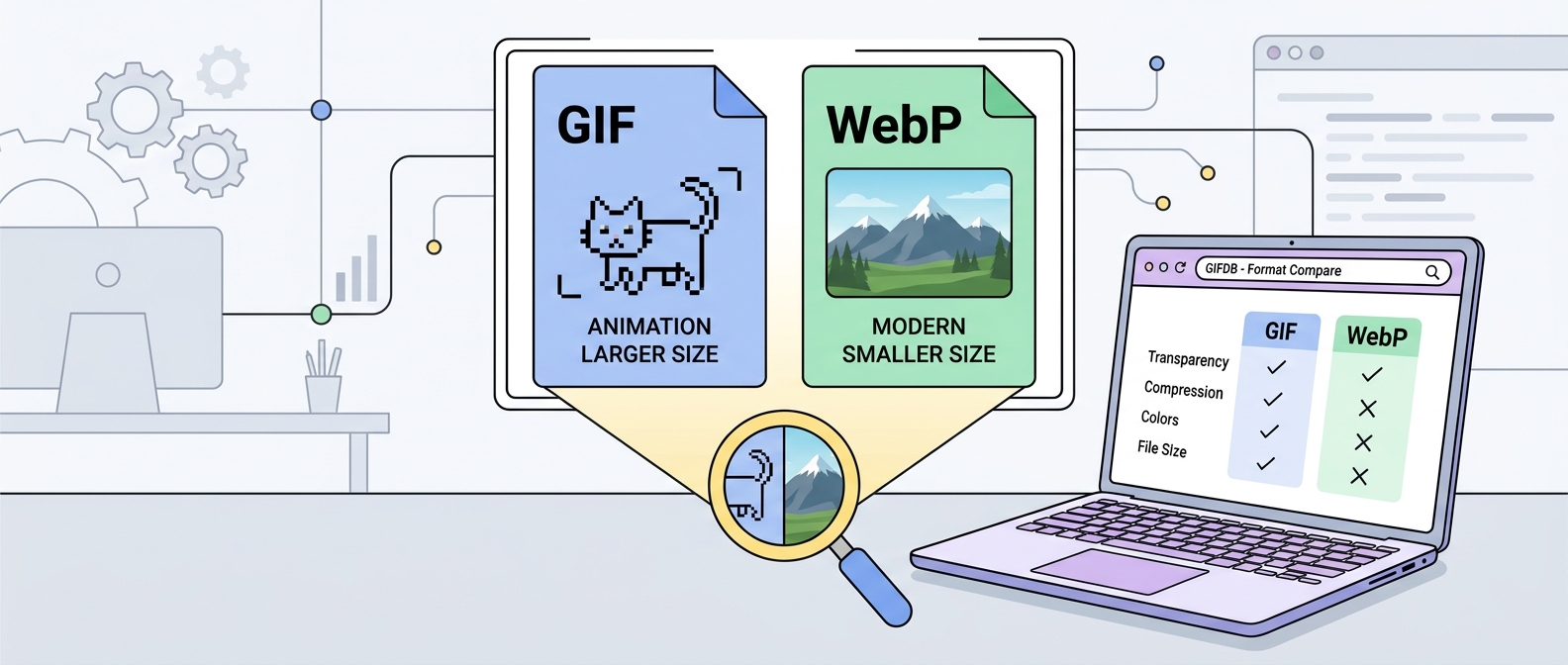
File Size
Animated WebP files are typically 40–60% smaller than equivalent GIFs for the same visual quality. Google's own tests showed WebP providing roughly 64% better compression than GIF for lossless animated content and even better results for lossy compression. For a website serving thousands of animated images, this size difference translates directly to faster load times and lower bandwidth costs. For a single GIF you are sending in a chat, the practical difference may be less relevant.
Color and Quality
WebP supports 24-bit RGB color with an 8-bit alpha transparency channel, meaning it can represent the full range of photographic colors without the 256-color palette limitation that causes GIF's characteristic dithering artifacts. A WebP animation of a natural landscape or a person's face can look genuinely photographic, which GIF simply cannot achieve. This quality advantage is substantial for content with gradients, skin tones, or detailed textures.
Browser Compatibility
This is WebP's weakness compared to GIF. All modern browsers support animated WebP — Chrome, Firefox, Edge, and Safari (since 2020) render it correctly. However, Internet Explorer does not support WebP at all, and very old versions of Safari (pre-2020) also lack support. GIF works in literally every browser ever made. If you are building a public-facing website and need guaranteed compatibility going back to legacy systems, GIF is safer. For modern web applications where you can assume current browser versions, WebP is the better technical choice.
Email Client Support
Animated WebP has even more limited support in email clients than in browsers. Most email clients do not animate WebP — they either display a static frame or break entirely. For email, GIF remains the only reliable option for animated content. WebP is not a viable email format today.
Transparency
Both formats support transparency. GIF supports binary transparency (a pixel is either fully transparent or fully opaque — no semi-transparency). WebP supports full alpha channel transparency, meaning pixels can be partially transparent, which enables smooth anti-aliased edges and complex compositing effects. For logos, icons, and graphics that need to blend cleanly over varied backgrounds, WebP's alpha support is a meaningful advantage.
Practical Recommendation
For web delivery where you control the serving environment and your audience uses modern browsers, animated WebP is the technically superior format. For email, legacy compatibility, or environments where you cannot guarantee WebP support, GIF remains the safer choice. The broader GIF format guide has more context on when each format is appropriate. For converting between video and GIF formats, the MP4 to GIF converter is the fastest option, and the GIF vs MP4 comparison covers the video format trade-offs in detail.